Anatomy of a Finished Stair: Skirts, Treads, Risers, and Rails
By Nicholas Dunn · July 28, 2026 · 6 min read
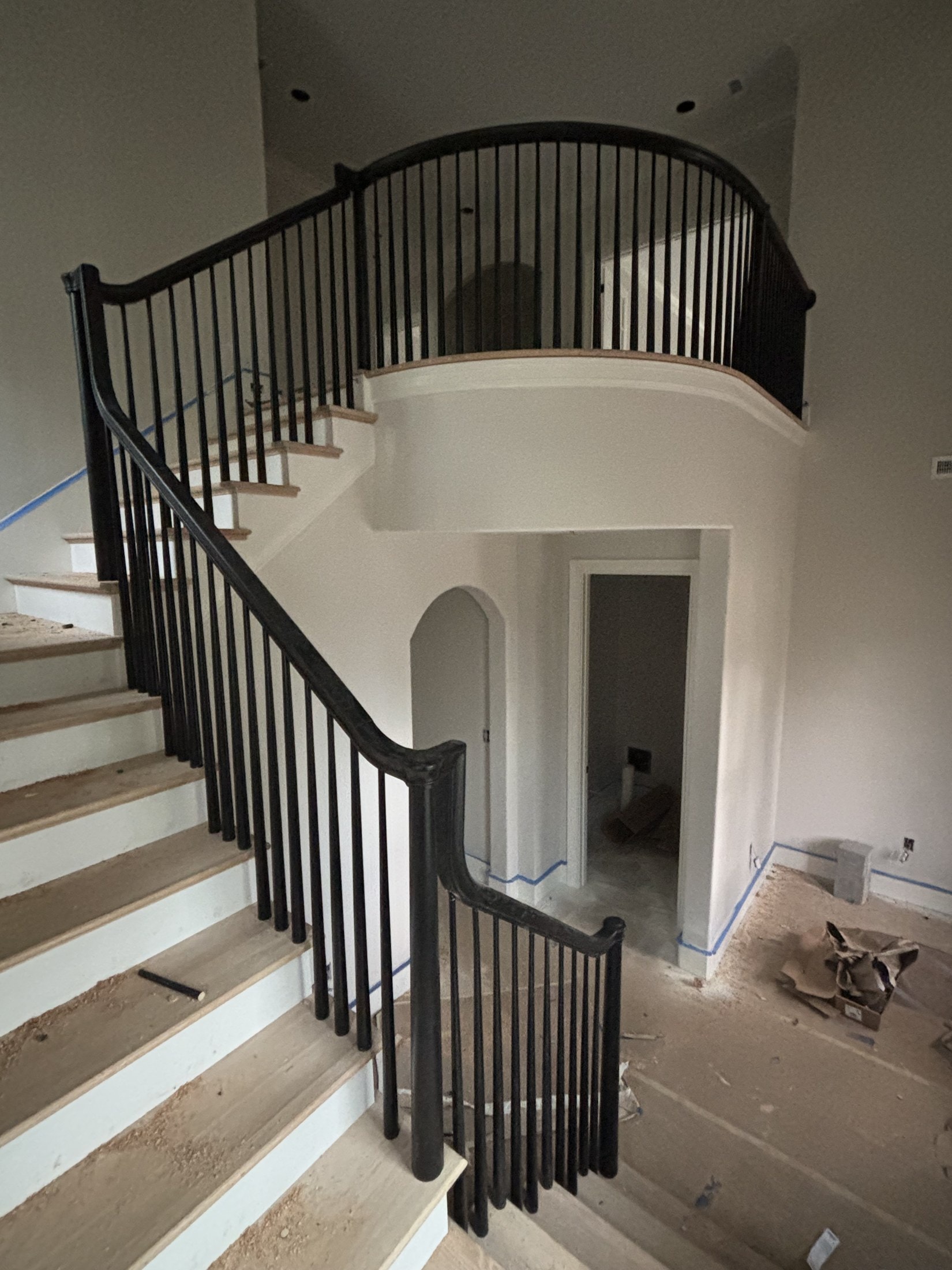
TL;DR
A finished stair is made up of a structural stringer, a decorative skirt board, treads, risers, newel posts, a handrail, and balusters — plus small details like tread returns and landing treads. The parts you can see (skirt, tread, riser, rail) are where craftsmanship shows. The parts you can't (stringer attachment, newel anchoring) are where stairs fail. Done right, a stair is the most expensive trim line per foot in the house — and the one people touch every day.
A staircase is the single hardest-working piece of finish carpentry in a house. You touch it every day, your kids run on it, your dog scratches it, and visually it's almost always the first thing people see when they walk in. So when a stair looks cheap, the whole house feels cheap — and when it's done right, it carries a room.
After about a decade installing trim across hundreds of homes, stairs are the one assembly where I see the widest gap between "builder grade" and "actually finished." Here's the full parts list, what each piece does, and where I see corners cut.
What are the parts of a staircase?
A finished stair is really two stacked things: the structure that holds you up, and the finish package that you see and touch. Both have names, and good specs call them out individually.
The structural parts
- Stringer: the sawtooth-cut framing member that carries the load. Stairs can be closed (stringer hidden behind walls on both sides), open on one side (the showy side, where balusters land), or open on both. Closed stringers get covered by a skirt board; open stringers either get a finished cap or get mitered to the riser for a cleaner look.
- Subtread and subriser: on most stick-framed stairs, there's a rough plywood tread and riser that the finish material lays over.
The finish parts
- Skirt board: a decorative board against the wall on a closed stair. Should be 1x10 or wider, painted, and scribed tight to every tread and riser.
- Tread: the part you step on. Usually red or white oak, 1" or thicker, with a bullnose front edge.
- Riser: the vertical face between treads. Often painted white, joined to the tread with either a simple butt joint or a tighter rabbeted joint.
- Nosing and tread return: the rounded overhang at the front of the tread. On an open side, the nosing should return back into the stair with a mitered end cap — not just get cut off square.
- Landing tread: the transition piece at the top of the run that matches the tread profile but sits flush with the upstairs floor.
- Newel post: the heavy anchor post at the bottom, top, and any turn.
- Handrail: the graspable rail. Code typically requires it to be between 1-1/4" and 2" in graspable cross-section.
- Balusters: the vertical spindles between rail and tread. Wood or iron.
What's a skirt board, and why does it matter so much?
The skirt is the single biggest tell of whether a stair was actually finished or just installed. A real skirt board is a wide, painted board — I want 1x10 minimum — that runs from the bottom of the stair up to the landing, scribed tightly so every tread and riser dies cleanly into it.
Cheap stairs skip the skirt entirely and just caulk the treads to the drywall. Slightly-less-cheap stairs use a 1x6, which looks skinny and gets cut into by the tread nosings. A proper scribed skirt looks like furniture; it's also one of the more time-consuming things on the whole stair, which is exactly why builders skip it. If you want one detail to put in your spec, that's it. (For how to write that spec, see how to write a trim specification.)
What's code for stair railing?
I'm a carpenter, not a code official, and codes vary by jurisdiction — so confirm anything load-bearing with your local building department. That said, here are the rules I work to on every job:
- Guard height: roughly 36" to 42" depending on whether it's a stair handrail or a guard at a landing.
- Handrail diameter: graspable, typically 1-1/4" to 2" in cross-section so an adult hand can actually close around it. Big chunky decorative rails often fail this — they need a separate graspable rail added.
- 4" sphere rule: baluster gaps must be tight enough that a 4" sphere can't pass through. That generally translates to balusters around 4" on center.
- Newel anchoring: not strictly "in the code" the way spacing is, but a newel that wobbles is a railing that will eventually fail under load.
How do you anchor a newel post correctly?
This is where I see the most outright bad work. A newel takes serious lateral load — every grab, every kid swinging around it. It cannot just be screwed to the top of the subfloor. It will wobble within months.
Correct anchoring options:
- Mortise into framing: the bottom of the newel passes through the subfloor and is bolted to a joist or a doubled block.
- Through-bolt hardware: a manufactured kit (commonly a long lag bolt drawn into a threaded insert) that pulls the newel down tight against the framing.
- Half-lap into a stringer: on an open stair, the newel can be notched and bolted directly to the stringer.
If you can grab the top of a finished newel and feel it move, it's wrong. This is one of the things I look for in a walk-through and one of the items on my list of signs of a good trim carpenter.
Painted vs. stained: how should you spec the materials?
The classic American stair is stain-grade white oak treads, handrail, and newels, with painted risers, skirts, and balusters. The oak takes the wear and shows grain; the painted parts lighten the stair visually and keep cost reasonable.
For a true focal stair — entry foyer, open to the great room — I'll often go stain-grade on the skirt and risers too. It's stunning, but you're roughly doubling the material and finishing time. Paint-grade everything is the budget end and works fine in a back stair. For more on that tradeoff, see stain-grade vs. paint-grade trim.
Why are stairs the most expensive trim line in the house?
Per linear foot, nothing else comes close. A stair combines hardwood material, multiple species, mixed paint and stain finishes, code-driven railing, structural anchoring, and a lot of scribing in a tight footprint. It's also the assembly where labor hours are hardest to compress without the work showing it.
This is why a stair line item on a quote can look shocking next to baseboard pricing. For context on how finish carpentry pricing works generally, I broke that down in how much does finish carpentry cost — and how good trim affects resale in does trim carpentry add home value.
Bottom line
A finished stair has a lot of named parts for a reason — each one is a place where the job either gets done right or gets faked. If you're a homeowner or a designer spec'ing a stair, the four details that matter most are: a real wide skirt scribed to the treads, tread nosings that return on open sides, newels anchored into framing, and balusters spaced for the 4" sphere rule. Get those right and the rest of the package tends to follow.
If you're planning a stair upgrade or new build and want a second set of eyes on the spec before anyone swings a hammer, book a free Discovery Call and we'll walk through it.
About the Author
Nicholas Dunn is a finish carpenter and the founder of Dunn Trim Co., with the better part of a decade at the saw. He helps homeowners, designers, architects, contractors, and trim companies get finish carpentry right. More about Nicholas →